
COMMUNITY eNEWSLETTER
DECEMBER 2025
Supporting children and adults on the autism spectrum across Sydney and Melbourne.
HELP US THIS DECEMBER
Your support can make a life-changing difference.
As the year draws to a close, please consider giving generously to support children and adults on the autism spectrum and their families who rely on our programs every day.
Your donation helps us continue delivering specialised education and support across Sydney and Melbourne.
Thank you – we can’t do it without you.
LUCKY IN THE HARDEST TIMES
Our family, and my beautiful little girl are such hard work, and we require so much effort that any other school in Australia would have asked us to leave years ago. They would have said, in the nicest way, “Go away, you are too hard, too much trouble”.
Our story is one of just surviving, just hanging on by our fingernails. We have needed a lot of help to do that, and most of it has come from Giant Steps.
This isn’t a story of how hard our life is, but rather, how lucky we are to be part of the Giant Steps community.
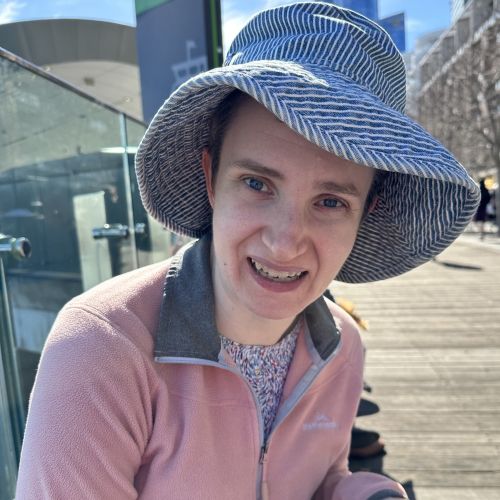
Our first bit of good luck happened not too long after Giant Steps was established. From a waiting list of more than 100, the school took on 3 new students, and we were one of them. Erica was five.
About 12 years later, we had some more good luck. When Erica was close to finishing school, we looked around to see what was available and were very concerned. The school came to the same conclusion as us, and Erica, along with a handful of other Giant Steps graduates were the pioneers of a post school program which opened in 2009.
Now in its 17th year and supporting 50 adults including Erica, I have no idea what we would have done if that option hadn’t appeared.
So, with all that good luck, what could possibly go wrong? Unfortunately, plenty, and throughout Erica’s teenage years into early adulthood we had a really tough time.
Erica is verbal, but only just. She has maybe 6 or 8 words. “Yes, no, Daddy, finish, no way, happy”. “Happy” is perhaps the best verbal interaction we have with her. On a good day she will put an arm around my shoulder, snuggle in and say “happy” in a satisfied tone. That is probably as close as we will ever get to her saying “love you”.
Erica can feed herself, maybe find something in the fridge or cupboard, but can’t prepare anything, even something basic, from scratch. She needs full assistance with dressing, bathing, cleaning teeth and taking medication. She has no road sense.
Erica doesn’t ‘get’ Christmas, or Easter, or birthdays. She is actually afraid of birthday candles. So those times of year, usually so full of joy for most families, aren’t big at our place.
When you are autistic, the world is often a confusing and even frightening place. How do you react when you are angry or confused? Or when you want to be left alone, but can’t tell anyone how you feel? Or frightened, sitting in a doctor’s waiting room. For Erica, her way to communicate displeasure was to hit, spit, pull hair, throw things, push over furniture, slam doors, break windows, or the TV. I always felt it must be terrible to be inside Erica’s frustrated head at such times, trying to get a message across, but unable to do so.
As a parent how do you deal with everyday life, how do you cope? You tend to avoid taking your child to the shops, or to social events. Or you tag team – one parent goes, one stays at home. One leaves early, one comes late. Simple things that other families take for granted like going to a restaurant on Mother’s Day, or even something as basic as McDonalds can become difficult or impossible.
It was easier to avoid these occasions. But unless you made a conscious effort, it was also easy to become isolated or even ostracised.
Over time, Giant Steps did a great job of helping Erica participate in lots of activities. Eventually, we could go to a coffee shop, or even a restaurant – if it was quick. These are important achievements, hard to measure but life changing.
As Erica moved into her teens, she began sleeping for long periods of time, up to 20 hours overnight, all weekend and day-after-day in the holidays. After years of testing by multiple specialists we finally got a diagnosis of bipolar disorder on top of her autism. The sleep was the predominant “down” phase of the bipolar.
As Erica got older, and had a surge in teenage hormones, she slept less but still had depression. But it changed, and presented as anger, aggression and agitation. She didn’t want to get up most mornings, her way of saying “go away, leave me alone” was very physical and we had enormous challenges every day when bathing and dressing her.
When College opened, every morning for the first 5 weeks we had a tremendous battle getting dressed, then hitting, spitting, pulling my hair and throwing things in the car as we drove towards Giant Steps. Then, when we arrived at College getting her out of the car and up the stairs was another battle. When I finally got her inside, she would hit and spit at staff, push furniture over, bang the TV, pull open the filing cabinets. Every day I was afraid they would say, “today is the final straw, take her away”. But no, the staff would welcome her and send me home. I would make a token offer to take her with me, then bolt as quickly as I could, before they had a chance to change their mind.
Erica did eventually settle, however, we had as many bad weeks as we had good ones over the next 2 years. But Giant Steps never gave up on us.
When Erica was 19 and we had endured months of relentless, daily challenges, we finally had to accept that we couldn’t manage her at home. We had to give up her care and put her into a group home. Was that our low point, did it get better from there? No, it got worse.
6 months after moving into the group home, something went wrong one night. Erica assaulted staff, and other residents. No-one knew what to do. Staff panicked and phoned the police, and 3 officers came. Erica started hitting one of them and they responded as they were trained to – they grabbed her, capsicum sprayed her in the face, wrestled her to the ground and handcuffed her face down on the concrete path. Then she was carted off to the psychiatric ward at Concord Hospital.
I was devastated. I felt I had failed our beautiful, fragile, confused, little baby girl, I should have been there to protect her. To save her from herself, but I had failed her. And if it was bad for us, imagine what it must have been like to be inside her head that evening. It took me months before I could talk about it without choking up and having my eyes fill with tears.
The only place we could turn to for help was Giant Steps. They rallied around us in unbelievable ways, rostered staff to be with her every day, even on the weekends.
Erica went into a deep depression. Wouldn’t eat, wouldn’t drink. We spoon fed her jelly and squirted water down her throat with a syringe and she hardly got out of bed for weeks.
For almost 18 months, Erica wasn’t well enough to attend College. But Giant Steps came to Erica.
What other organisation in Australia would do that for you? What other team of staff would have done what Giant Steps did for us? Any other place would have kicked us out years ago for being too hard.
We are very lucky to be part of Giant Steps.
Finally, slowly, Erica settled and her medication was fine-tuned. Life became better for us, but more importantly, it became better for Erica.
14 years on, Erica is living her best life yet – beautiful, smiling and happy. With the help of the NDIS and the combined efforts of 3 families, she is living in a purpose-built home with two other peers from Giant Steps. Erica attends College (now Adult Autism Services) and is constantly learning new skills, albeit it with slow, small steps.
Autism is for life. People like Erica who are profoundly autistic will need help for life. Giant Steps has been providing this help for our family for almost 30 years.
Ivana, my wife, and I, are still married. We haven’t killed each other… but are in fact coming up to our 36th wedding anniversary. The future for our whole family is looking much brighter and better than it has for years.
Ian Morris

A COMMUNITY THAT TRULY GETS IT
Remy is my 17-year-old son who is intellectually disabled and has complex autism.
He will never have the privilege of living independently and will require full-time support in every personal and social part of his life.
He does not have sophisticated language or speech to tell us how he feels, so we rely on his facial expressions, his sounds and his physicality to show us.
There is a BGS (Before-Giant-Steps) time for our family and then an AGS (After-Giant-Steps) story. BGS was a minefield of unknown quantities – would he be able to stay at school a whole day? Which school will he attend next year? What does Remy’s future look like? What does our family’s future look like? Now that we are in our AGS era, there is a security knowing that Remy’s future is safe with a community of peers, education experts and specialists that understand his world and create opportunities to expand and celebrate it.
Before Giant Steps, I couldn’t imagine Remy going on a hike through a national park or being part of a dance concert. His world didn’t include surf lessons or birthday parties. These are now all part of an average term for Remy and his cohort of peers. Giant Steps see the person before the diagnosis, the potential before the barriers, and in doing that, they help kids like Remy shine in ways we never thought possible.
What makes Giant Steps truly extraordinary is the way they tailor every moment of learning to each child’s needs, strengths and challenges.
Remy is not expected to fit into a mould; the program wraps around him. His team sees the whole person; his sensory world, his communication style, his anxieties, his passions, and they build an educational pathway that honours all of it. They understand that a child with complex needs sits at the centre of a much wider circle – siblings, parents, grandparents, support workers, friends. They walk alongside our entire family, acknowledging the emotional load, celebrating the wins, and reminding us that we are part of a community that truly “gets it”.
The impact of that can’t be overstated, it changes how a family breathes.
Over the past 10 years, Remy has woken up every morning and with his bright, eager eyes has asked “school?”. On the days that I get to say “yes, today you get to go to Giant Steps school” the joy that spreads across his body is infectious knowing that he will be welcomed, understood and engaged with.
What more could you want for any child?
Jess Stimson

MAKING THE EVERYDAY POSSIBLE
Every morning at Giant Steps, I see small moments that remind me why our work matters. One of our students, who once found it too overwhelming to enter the classroom, now walks in with a smile and proudly places his bag on its hook. That simple moment, something many people take for granted, took months of patient support, routines, visuals, sensory strategies, teamwork and trust.
These victories don’t happen by accident. They happen because our students have access to specialised programs, passionate staff and the resources they need to feel safe, confident and understood.
As an Occupational Therapist, I have the privilege of helping children discover new abilities, regulate their emotions and participate in the world in ways their families once wondered if they ever could.
At Giant Steps, Occupational Therapy plays a crucial role in helping students engage in their primary occupation of being a student. I work closely within a transdisciplinary team to ensure each child is supported across the classroom, playground, community and home environments. I value this collaborative approach because it strengthens every program and helps students generalise their skills across all settings.
Occupational Therapy focuses on building independence in self-care, emotional regulation, sensory processing, engagement and personal productivity. Many of our students experience sensory processing differences that affect the way they move, attend and regulate. By understanding these needs and tailoring supports around them, we aim to create environments and opportunities where students feel safe, capable and empowered.
For me, I’m helping a child take a step they never thought possible. And sometimes, that one small step changes everything.
Cheryl Toth, Director of Occupational Therapy – Secondary
PLAYSTEPS
Playsteps is a supported playgroup for children aged 2 to 4 years with an autism diagnosis and their parents or primary caregivers. Enrolments for 2026 are open.
FUNDRAISERS
We would like to acknowledge our incredible community of supporters whose generosity made recent fundraising events across Sydney and Melbourne possible. From Greek Night and Trivia, to High Tea, Lawn Bowls, the Festive Market, Dinner on the Rooftop, our first ever Music Festival and the 19th Annual Bike Ride, we are truly grateful for your continued commitment and support.
Giant Fest – Melbourne
Held on Sunday 26 October, The Timber Yard
Gold Sponsors: Bambini Early Learning, Architecture Works, Serene Body Health


Sydney
Chinese New Year
Saturday 7 March
Virtually New To You
Saturday 28 March
Drag Bingo
Saturday 18 April
Annual Gala Ball
Saturday 13 June


Melbourne
Greek Night
Saturday 21 March
Giant Steps Melbourne Ball
Saturday 8 August

A DECADE OF IMPACT
Future Generation Australia has played a pivotal role in the growth of Giant Steps over the past 10 years, helping us expand our programs and reach more children and families. Their cornerstone support made it possible to open Giant Steps Melbourne, launch the Autism Training Hub, build our operational capacity and transform learning outcomes for students. We’re humbled and proud to continue as a social impact partner.
Support Our Work
Giant Steps Australia is a registered charity and donations are tax deductible.
THANK YOU FOR YOUR SUPPORT